Girl, Woman, Othered? Why women’s safety must be a priority for placemaking
Content warning: mentions of violence and sexual assault.
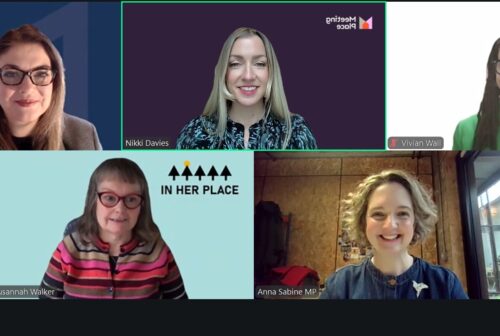
For International Women’s Day, Meeting Place convened a panel of experts to explore why planning still overlook the safety and lived experience?
Hosted by Meeting Place’s Nikki Davies, the discussion examined the disconnect between women’s safety and planning policy, the real-world implications for the built environment and what meaningful, more inclusive planning could look like in practice.
Joining the conversation were Charlotte Morphet of Women in Planning and the University of the Built Environment, Susannah Walker of In Her Place, Vivian Wall of Motionspot and Anna Sabine, MP for Frome and East Somerset.
A policy blind spot with real world consequences
Much of the conversation focused on the emerging version of the NPPF and the absence of any meaningful reference to women and girls within it.
Anna explained how this issue was raised with government after concerns emerged that the draft framework failed to reflect the realities of women’s safety. The response suggested planning policy and violence against women and girls were considered separate issues rather than interconnected ones.
That disconnect became something of a recurring theme.
Charlotte outlined where the biggest blind spots appear in the NPPF. The framework refers broadly to communities, accessibility and inclusion, but it assumes a gender-neutral public. In practice, this means the policy language overlooks the fact that different groups experience places differently.
Women and girls are not referenced explicitly across the framework’s policies on communities, transport or accessibility. Even where safety is mentioned in planning guidance, it tends to appear in narrow design contexts rather than as a central planning policy consideration. As the panel noted during the discussion, there is detailed guidance on issues such as lighting for bats, yet far less clarity on how the built environment should be designed to support women’s safety.
Charlotte also highlighted how the framework places strong emphasis on evidence-based planning, yet there is no requirement to collect sex-disaggregated data that would reveal how different groups experience places.
Without that evidence, gender differences risk remaining invisible.
Susannah went further, arguing that it’s not just a moral imperative, but a question of legal responsibility. Public bodies are required to actively address discrimination through the public sector equality duty. If women’s experiences are not considered in policy frameworks such as the NPPF, that raises serious questions about how equality duties are being met.
It was a disconnect neatly summed up as: “TLDR… So not only is it illegal, but it’s the right thing to do.”
Safety is only the starting point
The discussion repeatedly returned to the wider ways the built environment shapes women’s participation in public life. Lighting matters. Route visibility matters. So do overlooked corners, isolated paths and disconnected transport links
The panel emphasised that women’s safety should not be reduced to a single, tokenistic design fix.
Planning decisions influence how people travel, where homes are located, how services are accessed and whether public space feels welcoming. If policy frameworks such as the NPPF do not consider these realities early on, they risk entrenching inequalities.
Susannah pointed out that safety often becomes the entry point for these discussions because it is measurable and easier to raise within policy frameworks. Yet safety is only the beginning.
“Safety is such a low bar. We need to be asking much more than just ‘are we not being raped, not being murdered’? It’s about a right to be equal in public space and a right to enjoy it.”
Nikki illustrated this through the everyday habits many women adopt when moving through public spaces.
Women and girls are often taught to stay alert, avoid certain routes and be prepared to defend themselves.
As she put it, women are frequently told to “keep yourself safe, have your wits about you, lace that key between your fingers” when walking home at night.
It was a powerful reminder that the built environment does not just shape places. It shapes our behaviours and expectations too.
Why engagement must go deeper than consultation
Vivian brought a practical perspective to the conversation through her work in inclusive design.
She suggested that inclusive places cannot be achieved through policy language alone. They require meaningful engagement with people who experience places differently.
Too often engagement happens late in the design process or is treated as a tick-box exercise. Instead, a diverse range of voices should be involved throughout the lifecycle of a project, from early concept through to design development.
Vivian also highlighted the importance of recognising intersectional experiences. Women are not a single group with identical needs. A disabled woman, a neurodivergent woman, an older woman or a parent travelling with children may experience the same place very differently.
The panel also discussed how relying solely on crime statistics can be misleading. Many experiences of harassment or fear in public space are never reported, meaning the data may not reflect how people actually feel when using a place.
What should happen next
While the conversation began with the NPPF, it concluded with a reminder that change does not need to wait for national policy reform.
Anna encouraged attendees to raise the issue with their MPs and to ensure policymakers understand why gender-responsive planning matters.
Charlotte called for better evidence collection, including sex-disaggregated data, to strengthen planning policy and local plan development.
Vivian urged developers and project teams to establish lived experience panels that bring diverse perspectives into the design process from the outset.
As Nikki concluded, meaningful change does not need to wait for the next revision of the NPPF.
Even where policy frameworks fall short, those working in planning, development and design can choose to apply a gendered and intersectional lens to their work today.
Resources:
- In Her Place – Planning for Equality – https://www.inherplace.co.uk/post/planning-for-equality
- Invisible Women: Exposing Data Bias in a World Designed for Men, Caroline Criado-Perez – https://www.amazon.co.uk/Invisible-Women-Exposing-World-Designed/dp/1784741728
- RIBA Inclusive Design Overlay – https://www.riba.org/work/insights-and-resources/inclusive-design-overlay-to-riba-plan-of-work/
- Green Flag Award safer parks guidance – https://www.greenflagaward.org/resources/safer-parks-for-women-and-girls/safer-parks-for-women-and-girls/
