Outside the community hall: Digital engagement unlocks urban transformation
Consultation has traditionally relied on in-person events, pull-up banners and paper feedback forms to gather community insight. While these activities are often considered essential, do they truly represent meaningful engagement when attendance barely reaches double figures in a busy urban neighbourhood?
Our recent consultation campaigns for two regeneration projects in Bristol demonstrate the power of a more strategic digital approach. Not only has digital engagement proven more efficient, it has also created a more accessible way to reach a broader, more representative cross-section of the local community, enabling us to gather richer feedback and build genuine support.
Let’s talk about numbers
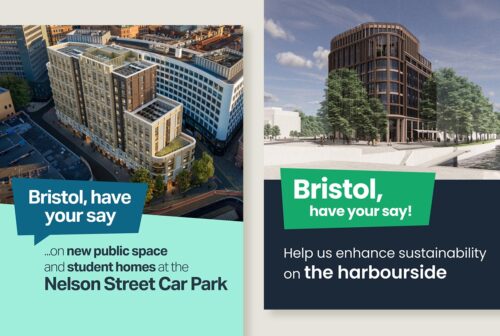
For Broad Quay House in Bristol’s harbourside, which proposes a deep retrofit project transforming the existing building into modern, sustainable office space, our digital campaign delivered remarkable results.
Through targeted social media and a streamlined landing page, we reached over 115,000 people, generated over 4,100 click-throughs to the consultation website, and achieved over 352,000 impressions. This led to 568 feedback forms being completed, with 42% of those being supportive of the proposals.
We also ran a campaign for the regeneration of Nelson Street car park into student accommodation that reached over 70,000 people, generated over 2,400 website visits, and delivered over 230,500 impressions.
What we also found successful was the diversity of demographics who were taking part in the consultation, including those groups that might not ordinarily attend a community hall setting. One example of this is that the most common age group for the participants was 25 to 34 years old (35%), which is one of the age groups that engages in civic consultation the least, according to the Department for Culture, Media & Sport Community Life Survey 2024/25[1].
Why digital engagement works
These campaigns demonstrate three main benefits of using digital consultation techniques:
Scale and reach – Traditional consultation methods might reach double or triple digits of attendees and responses, but digital channels allow us to engage thousands across diverse demographics, from young professionals to established residents, all with different backgrounds and preferences for engagement, making the feedback truly representative of the local area.
Efficiency – Both campaigns prove that you don’t have to choose an overly lengthy consultation to achieve meaningful engagement. An eye catching and well-designed digital campaign can deliver substantial reach and impactful feedback.
Accessibility – Digital engagement reaches people where they are, whether that’s scrolling through social media during their commute, or at home on the sofa. There’s no need to rearrange schedules, or travel at a specific time.
Next generation consultation
What has been set out above isn’t about replacing in-person and traditional methods of consultation; it’s about exploring alternative methods for ensuring that consultations are accessible and representative, unlocking potential and helping shape people’s hometowns. Digital engagement and social media provide us with an efficient and successful way of doing this.
[1] Department for Culture, Media & Sport, Community Life Survey 2024/25:Civic engagement and social action (December 2025) – https://www.gov.uk/government/statistics/community-life-survey-202425-annual-publication/community-life-survey-202425-civic-engagement-and-social-action#civic-consultation
